
Outstanding Ukrainian scientists: Ivan Yakovych Horbachevsky
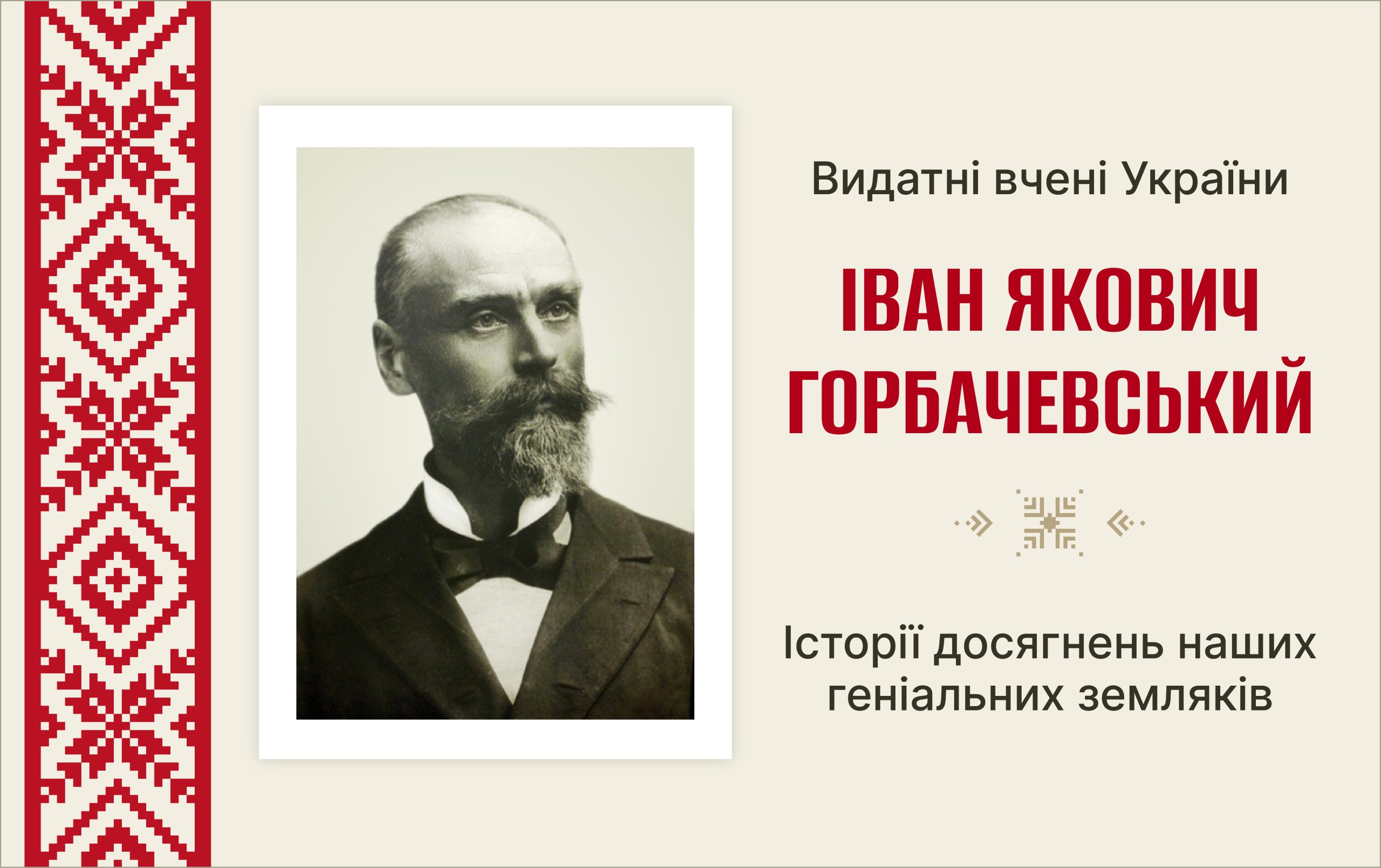
With this post, we are launching a new series where we will highlight prominent Ukrainian scientists. We decided to start with names familiar to us from the titles of Ukrainian medical universities. Our first spotlight is on Ivan Yakovych Horbachevsky, after whom Ternopil National Medical University is named. Today, May 15, marks his birthday (born in 1864).
Ivan Horbachevsky was born in the village of Zarubyntsi in the Ternopil region, into the family of a Greek-Catholic priest. He studied medicine in Vienna and devoted 35 years of his life to scientific and teaching work at the Department of Medical Chemistry at Charles University in Prague. He served as Dean of the Faculty of Medicine, Rector of the university, the first Minister of Public Health of the Austro-Hungarian Empire, Rector of the Ukrainian Free University, and was even nominated for the Nobel Prize. This short list of positions alone reflects how extraordinary a figure Ivan Horbachevsky was.
During his time in Vienna, Ukrainian students invited him to lead the “Sich” society. Ivan Franko wrote the following about this:
“… Within the very ‘Sich’, people emerged who didn’t just live off the university’s bread but truly dedicated themselves to science — not for a position or a career — such as Iv. Puluj, Iv. Horbachevsky, and others. From the beginning, they formed a quiet opposition to the noisy tavern life of ‘Sich’ and to the ‘Ruthenianism’.”
It’s incredible how many Ukrainian geniuses were working in Vienna at the same time and maintained warm, friendly relationships. One can only imagine the inspiring atmosphere this kind of dream team created.
Horbachevsky’s most important and well-known scientific work — “Synthesis of Uric Acid” — was published in 1882 and caused a sensation in the scientific world. It marked a major breakthrough in organic synthesis. Thanks to this discovery, Horbachevsky was invited in 1883 to join Charles University as a professor. It was there that he continued his scientific work and essentially became the founder of a new field: biochemistry.
It’s especially worth noting that although Horbachevsky spent 70 of his 88 years abroad, he remained a Ukrainian scholar and an active ambassador of his homeland. Even in his high school years, he led a secret society called “Hromada,” which worked to promote Ukrainian culture and literature. Despite a successful career in Austria-Hungary and Czechoslovakia, he continued to support the Ukrainian academic community, was a member of the Shevchenko Scientific Society, an academician of the All-Ukrainian Academy of Sciences, and actively contributed to the development of Ukrainian science and education. He remained a symbol of national identity and loyalty to Ukraine.
“I am eagerly awaiting the happy moment when all our scholars, scattered across the world, will be able to work together on their native soil for the glory and benefit of Ukrainian and world science,”
— wrote Ivan Yakovych Horbachevsky in a greeting card to the participants of the Congress of Natural Scientists and Doctors in Lviv, dated June 2, 1927. These words clearly reflect his life’s core belief.
The stories of the achievements of our brilliant compatriots are a source of inspiration and guidance for our team. We are eager to share this example and believe that — just as in the past — great talents are still being born in Ukraine today!
#IvanHorbachevsky #ProminentScientists #History #TNMU #TernopilCity
Sources: Lecture by Professor Mykhailo Korda at the XII Ukrainian Biochemical Congress, the article “Ivan Horbachevsky – A Prominent Scientist, Public and Political Figure” in the newspaper Medical Academy, Sept. 27, 2019, and Ukrainian Wikipedia.